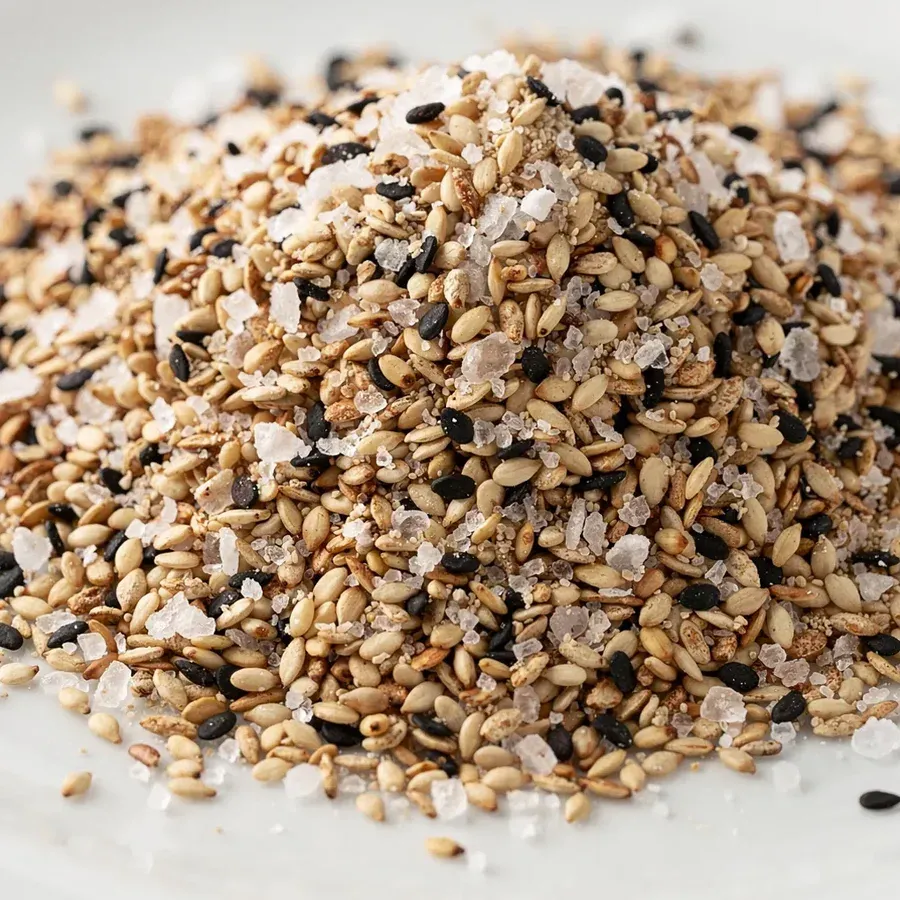
- Furikake variety
- ごま塩
Gomashio
Two ingredients, five hundred years.
Flavor profile
The strengths are editorial judgments on a scale within the family, not measurements. They can be compared across the furikake varieties, not directly against another family.
Gomashio is toasted sesame and salt, nothing else, which makes it the family's simplest and oldest form. The blend is mentioned in the 1500s, long before the word furikake existed. The seeds sit whole in the jar, which makes this the variety that holds its crunch the longest: it does not soften on steaming-hot rice but still cracks between the teeth. The classic use is over sekihan, the celebratory rice with azuki beans.
Sensory analysis
Pyramid and character
Aroma
from the jar
- toasted sesame
- nut
Taste
on the rice
- salt
- nuttiness
- oil
Finish
what lingers
- short
- clean
- dry
Character 0-100 per axis, set relative to the other entries in the same family. An editorial judgment of a typical serving, not measurements.
Background
Facts
- Contents
- toasted sesame and salt; the sesame can be white or black, and some commercial versions include sugar
- Blend
- between five and fifteen parts sesame to one part salt, depending on taste and use
- History
- mentioned in a diary from Ishiyama Honganji in 1536, well before modern furikake
- Sekihan
- the classic use is to sprinkle it over sekihan, the rice with azuki beans served at celebrations
- Macrobiotics
- in macrobiotic cooking it is ground by hand in a suribachi, the ridged mortar, and the salt is brought down to one part in eighteen
- Homemade
- the only furikake variety that is reasonable to make yourself on the spot, since it has two ingredients
On the food
Use
- Dosage
- one teaspoon per serving; the salt sets the dose, not the sesame
- Surface
- sprinkled over steaming-hot rice, where the moisture holds the seeds; on dry food they roll off
- Note
- toast the sesame until it smells fragrant and starts to jump, not until it darkens, because burned sesame turns bitter and cannot be saved
Evidence
Sources
- Gomashio (Wikipedia) (retrieved 2026-08-12)
- Furikake (Wikipedia) (retrieved 2026-08-12)
Compiled by Basim Ali Yoshiguchi. .