- Spice
- 辛子
Karashi
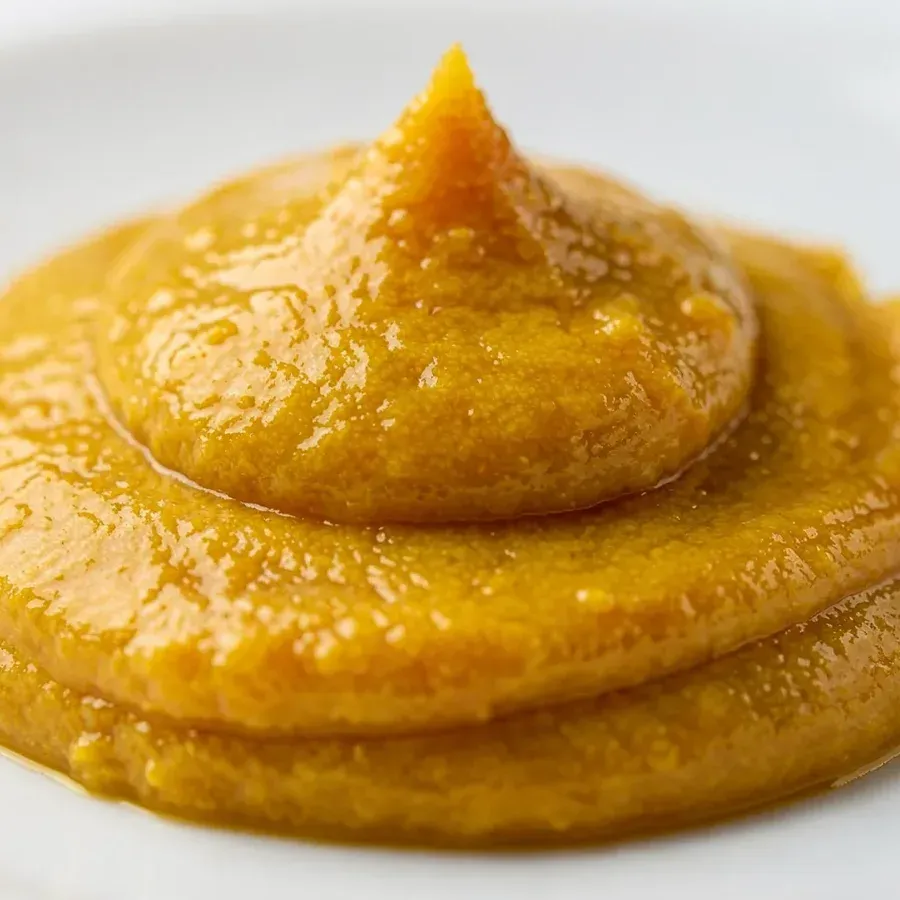
Mustard without vinegar, so nothing but bite.
Flavor profile
The strengths are editorial judgments on a scale within the family, not measurements. They can be compared across the spices and yakumi varieties, not directly against another family.
Karashi is Japanese mustard, and the difference from European mustard is that there is no vinegar or sugar to soften it. It is brown mustard seed and water, which is to say pure bite, and it flares up in the nose the same way wasabi does, because the same kind of compound is behind it. It is served as a small dab beside oden, tonkatsu, shumai, and natto, never as a sauce.
Sensory analysis
Pyramid and character
Aroma
from the jar
- mustard
- sharp
- green
Taste
on the tongue
- bite
- bitterness
- mustard
Finish
what lingers
- short
- cooling
- dry
Character 0-100 per axis, set relative to the other entries in the same family. An editorial judgment of a typical serving, not measurements.
Background
Facts
- Raw material
- brown mustard, Brassica juncea, ground to a powder or sold as a ready-made paste
- The compound
- allyl isothiocyanate, the same group of compounds as in wasabi, and with it the same volatile heat that travels upward instead of staying on the tongue
- Preparation
- the powder is stirred with lukewarm water and left covered for a few minutes, because the heat forms in a reaction that needs time
- Use
- oden, tonkatsu, shumai, and natto; also blended with mayonnaise or with vinegar and miso for a dipping sauce
- Karashi renkon
- a specialty from Kumamoto in which the holes of a lotus root are filled with karashi miso, deep-fried, and sliced
At the table
Use
- Dosage
- a dab the size of a pea is enough for one serving
- Timing
- stirred together just before serving and used cold
- Note
- the heat suffers both from boiling water and from sitting out, so mix a small amount at a time in lukewarm water
Evidence
Sources
- Karashi (Wikipedia) (retrieved 2026-08-12)
- Wasabi (Wikipedia), om allylisotiocyanat (retrieved 2026-08-12)
Compiled by Basim Ali Yoshiguchi. .