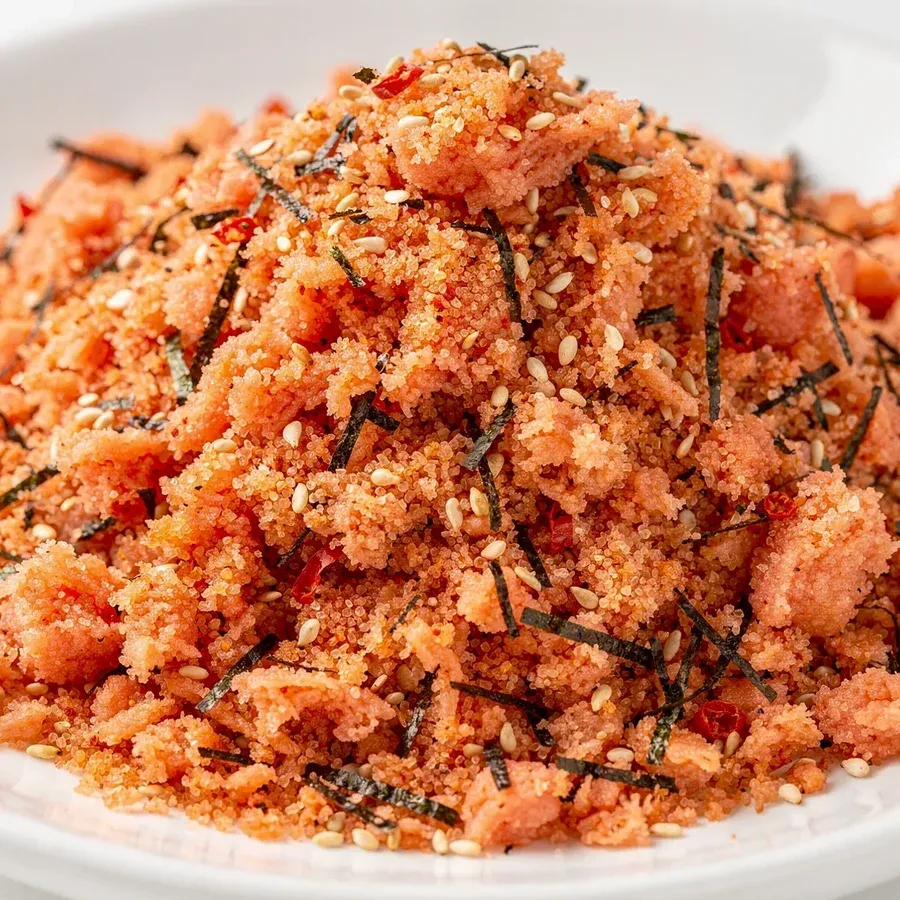
- Furikake variety
- 明太子ふりかけ
Mentaiko-furikake
Fukuoka's roe, dried and hot.
Flavor profile
The strengths are editorial judgments on a scale within the family, not measurements. They can be compared across the furikake varieties, not directly against another family.
Mentaiko-furikake is dried, chili-cured Alaska pollock roe with nori, sesame, and bonito, and it is Fukuoka's contribution to the family. Fresh karashi mentaiko is the city's signature product, but it keeps for a few days, while the dried form stands in the pantry for months and still carries the salty, roe-rich, lightly hot character. The heat here is the chili's: it builds slowly on the tongue instead of flaring up in the nose.
Sensory analysis
Pyramid and character
Aroma
from the jar
- roe
- chili
- ocean
Taste
on the rice
- umami
- saltiness
- heat
Finish
what lingers
- long
- hot
- salty
Character 0-100 per axis, set relative to the other entries in the same family. An editorial judgment of a typical serving, not measurements.
Background
Facts
- Raw material
- roe from Alaska pollock, the same fish that gives us surimi, salted and then steeped in a seasoning liquid
- Origin
- karashi mentaiko was developed by Toshio Kawahara in Fukuoka, who grew up in Busan and built on the Korean myeongnanjeot; his shop Fukuya opened in October 1948 and the first product was sold on January 10, 1949
- The marinade
- Kawahara's move was to skip the Korean chili paste and lay the roe in a liquid of dashi, sake, soy sauce, kombu, and yuzu, the same broth thinking as the rest of the cuisine
- Heat
- chili heat that builds on the tongue and stays, unlike wasabi's, which flares up in the nose and disappears
- The role
- the most assertive variety on rice and the only one usually recommended with hot water poured over, as a quick ochazuke
On the food
Use
- Dosage
- one teaspoon per serving; the salt is high and the roe is strong
- Surface
- warm rice, ochazuke with hot water or tea, fried rice, and pasta with butter
- Note
- this one is also a sauce base: a teaspoon in butter and cream becomes a mentaiko pasta in the time it takes to boil the spaghetti
Keep exploring
Related in the Zukan
- FurikakeFamily
- Katsuo-furikakeFurikake variety
- YukariFurikake variety
- Wasabi-furikakeFurikake variety
- DashiConcept
Shop and journal
At Nekko
Evidence
Sources
- Mentaiko (Wikipedia) (retrieved 2026-08-12)
- Karashi mentaiko (Food in Japan) (retrieved 2026-08-12)
- Furikake (Wikipedia) (retrieved 2026-08-12)
Compiled by Basim Ali Yoshiguchi. .