- Sea vegetable
- ひじき
Hijiki
The black strand that carries a warning.
Flavor profile
The strengths are editorial judgments on a scale within the family, not measurements. They can be compared across the seaweed and kelp varieties, not directly against another family.
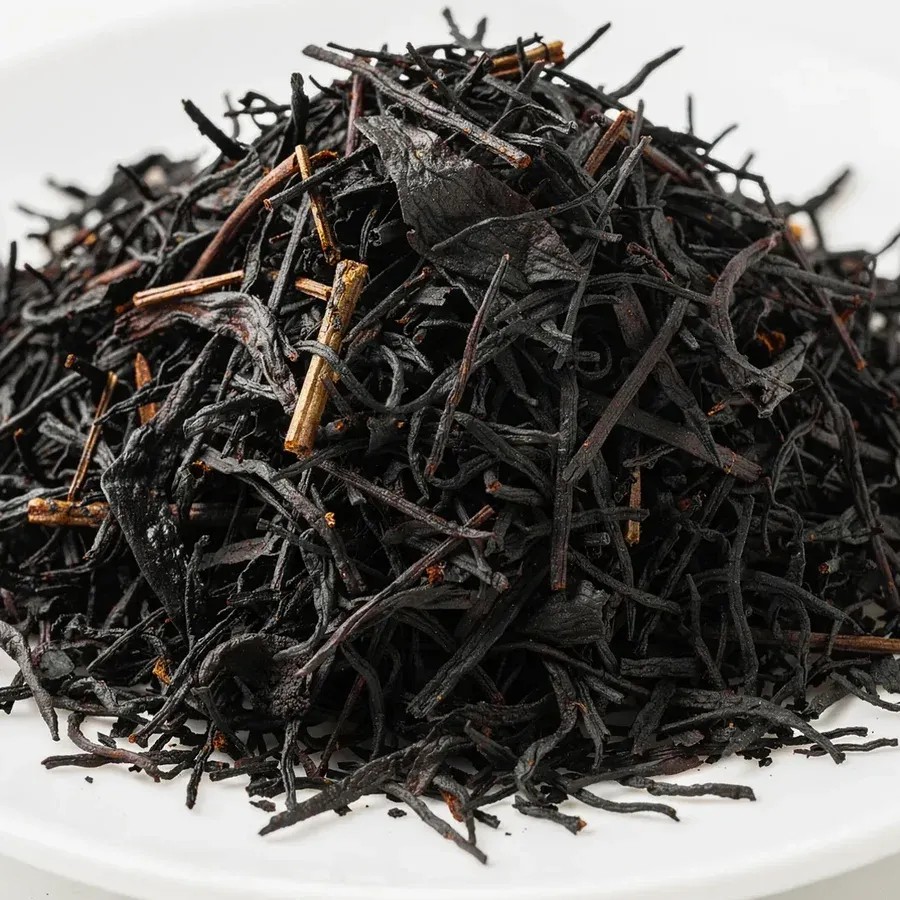
Hijiki is short black strands of brown algae, boiled and dried before sale, then soaked and simmered in soy sauce, mirin and sugar. The result is one of Japan's most home-cooked little side dishes. It is also the only common Japanese sea vegetable that food authorities in several countries advise against eating: hijiki binds inorganic arsenic at far higher levels than the other varieties, which have been tested without findings. This entry is here so that question can be looked up, not because the tea or the pantry needs it.
Sensory analysis
Pyramid and character
Aroma
from the bag
- dried seaweed
- earth
- dark ocean
Taste
on the tongue
- mineral
- firm bite
- dark ocean tone
Finish
what lingers
- dry
- long
- slightly bitter
Character 0-100 per axis, set relative to the other entries in the same family. An editorial judgment of a typical serving, not measurements.
Background
Facts
- Raw material
- brown algae, Sargassum fusiforme, growing wild on rocky coasts in East Asia
- Processing
- harvested with a sickle at low tide, then boiled and dried; the drying turns it black
- Use
- hijiki no nimono, the strands simmered in soy sauce and sugar with carrot, soybeans or tofu
- Warning
- the food authorities of Canada, the United Kingdom and Hong Kong advise against eating hijiki because of inorganic arsenic, which is carcinogenic
- Other varieties
- the same surveys found no corresponding levels in nori, kombu, wakame, arame or dulse
In the kitchen
Use
- Soaking
- 20 to 30 minutes in plenty of cold water, which is poured off
- Method
- then simmered in soy sauce, mirin and sugar until the liquid has almost cooked away
- Note
- the soaking water is always discarded, both for the flavor and because part of the arsenic leaves with it
Evidence
Sources
- Hijiki (Wikipedia) (retrieved 2026-08-12)
- Inorganic arsenic and hijiki seaweed consumption (Canadian Food Inspection Agency) (retrieved 2026-08-12)
Compiled by Basim Ali Yoshiguchi. .