- Sea vegetable
- あおさ
Aosa
What is in the bag when the label says aonori.
Flavor profile
The strengths are editorial judgments on a scale within the family, not measurements. They can be compared across the seaweed and kelp varieties, not directly against another family.
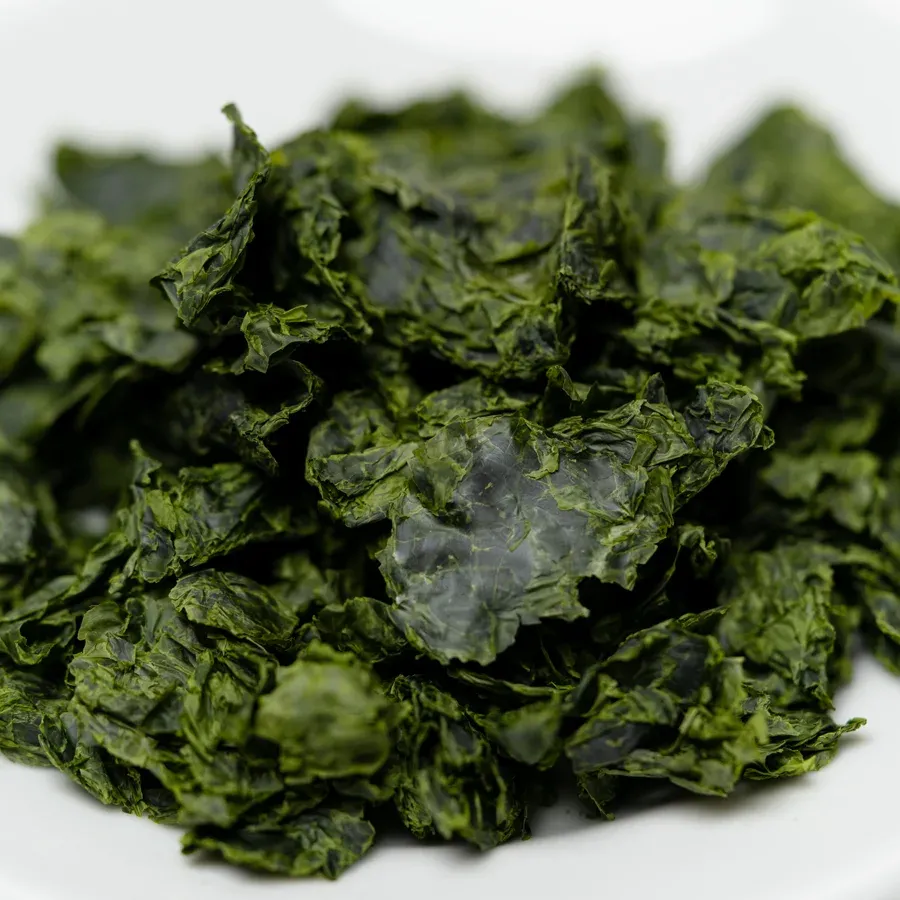
Aosa is the green seaweed most often found in the bag when the label says aonori. The blade is a single cell layer thick, which makes it softer and milder than the threaded aonori types, and it is used accordingly: a pinch in the miso soup, a handful in the tempura batter, or simmered down into tsukudani. It is also one of the most magnesium-rich foods in the Japanese nutrition tables.
Sensory analysis
Pyramid and character
Aroma
from the bag
- mild seaweed
- green notes
- ocean
Taste
on the tongue
- greenness
- mild umami
- ocean tone
Finish
what lingers
- short
- clean
- fresh
Character 0-100 per axis, set relative to the other entries in the same family. An editorial judgment of a typical serving, not measurements.
Background
Facts
- The name
- あおさ in hiragana is the trade name for hitoegusa; アオサ as a biological name is the genus Ulva, an entirely different order, so whoever buys aosa rarely gets what researchers call aosa
- Kinship
- described in 1866 as Monostroma nitidum; Japanese farmed material was moved to Monostroma kuroshiense in 2015 and on to the genus Gayralia in 2022
- Structure
- the blade is one cell layer thick, while the Ulva species have two, and that is the entire difference in mouthfeel
- Cultivation
- farmed on nets in sheltered bays; Mie accounts for over 60 percent of Japanese production, with harvest from January to April
- Amount
- around 3,000 to 5,000 tons a year in fresh weight, which comes to 600 to 700 tons dried
- Nutrition
- dried aosa contains around 3,200 mg magnesium, 490 mg calcium and 5.3 mg iron per 100 g
- Confusion
- the cheap sprinkle aonori is in practice often aosa, since it costs a fraction of threaded suji-aonori
- Use
- miso soup, tsukudani, tempura and senbei; the aroma only opens up when hot broth hits the flakes
In the kitchen
Use
- Dosage
- a pinch per bowl of soup, sprinkled in at the last second
- Temperature
- added after the soup comes off the heat, never into boiling liquid
- Note
- it swells more than it looks like it will and turns silky in liquid; if it is to stay crisp it must not meet moisture until it is on the plate
Keep exploring
Related in the Zukan
- Seaweed and kelpFamily
- AonoriSea vegetable
- NoriSea vegetable
- MozukuSea vegetable
- FurikakeFamily
Shop and journal
At Nekko
Evidence
Sources
- ヒトエグサ (japanska Wikipedia) (retrieved 2026-08-12)
- あおさのり(ヒトエグサ)の栄養素や食べ方, odlingen i Ise-Shima (retrieved 2026-08-12)
- Monostroma (Wikipedia) (retrieved 2026-08-12)
Compiled by Basim Ali Yoshiguchi. .