- Sea vegetable
- 海苔
Nori
The paper of the sea, toasted and crisp.
Flavor profile
The strengths are editorial judgments on a scale within the family, not measurements. They can be compared across the seaweed and kelp varieties, not directly against another family.
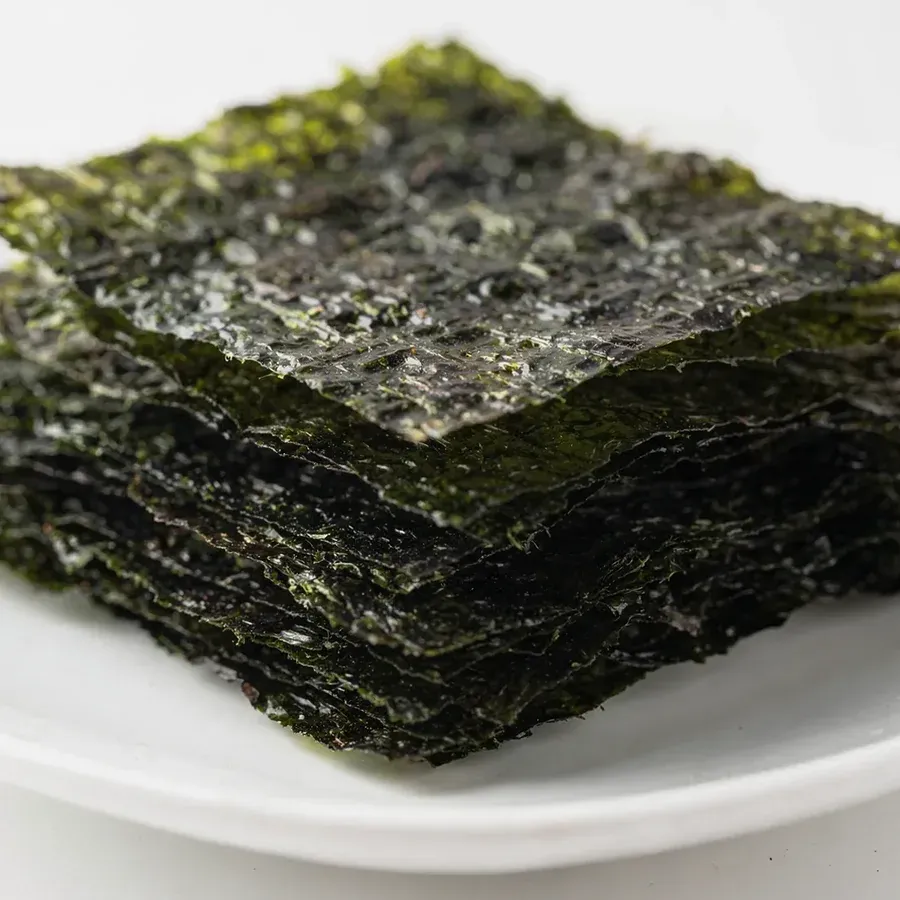
Nori is red algae mashed into a slurry, spread in thin layers on frames and dried into sheets: papermaking with algae in place of wood. Most sheets sold are toasted (yaki-nori), and the toasting is what gives the nutty, almost popcorn-like tone. The sheet is also the form's limitation: nori goes on in pieces, it does not sprinkle evenly, and it loses its crispness the moment it meets moisture.
Sensory analysis
Pyramid and character
Aroma
from the bag
- toasted seaweed
- nuttiness
- ocean
Taste
on the tongue
- umami
- saltiness
- toasted tone
Finish
what lingers
- dry
- nutty
- clean
Character 0-100 per axis, set relative to the other entries in the same family. An editorial judgment of a typical serving, not measurements.
Background
Facts
- Raw material
- red algae of the genus Pyropia, mainly P. yezoensis and P. tenera
- Processing
- the algae are minced fine, spread on frames and dried into sheets, much like handmade paper
- Variants
- yaki-nori (toasted, the standard sheet) and ajitsuke-nori (seasoned with soy sauce, sugar, sake and mirin)
- Flavor core
- glutamate 170 to 1350 mg per 100 g according to the Umami Information Center, which makes it one of the most umami-rich dried goods after kombu
- Cultivation
- about 45 days from seeding to first harvest, then a new harvest roughly every ten days
- Storage
- the sheets draw moisture from the air and turn chewy; store airtight, ideally with a desiccant
In the kitchen
Use
- Use
- sushi and maki, wrapping for onigiri, shredded over rice, noodles and soups
- Method
- warm the sheet briefly over a low flame or in a dry pan if it has gone chewy; the crispness comes back
- Note
- put nori on the food last; a sheet that sits in soup for a minute is no longer a sheet
Keep exploring
Related in the Zukan
- Seaweed and kelpFamily
- AonoriSea vegetable
- KombuSea vegetable
- UmamiConcept
- FurikakeFamily
- Nori komiFurikake variety
- AosaSea vegetable
- Spices and yakumiFamily
Evidence
Sources
- Nori (Wikipedia) (retrieved 2026-08-12)
- Seafood (Umami Information Center), glutamattabell (retrieved 2026-08-12)
- Nekko Journal: Nori vs aonori (retrieved 2026-08-12)
Compiled by Basim Ali Yoshiguchi. .