- Sea vegetable
- もずく
Mozuku
Okinawa's slippery strands, always cold and tart.
Flavor profile
The strengths are editorial judgments on a scale within the family, not measurements. They can be compared across the seaweed and kelp varieties, not directly against another family.
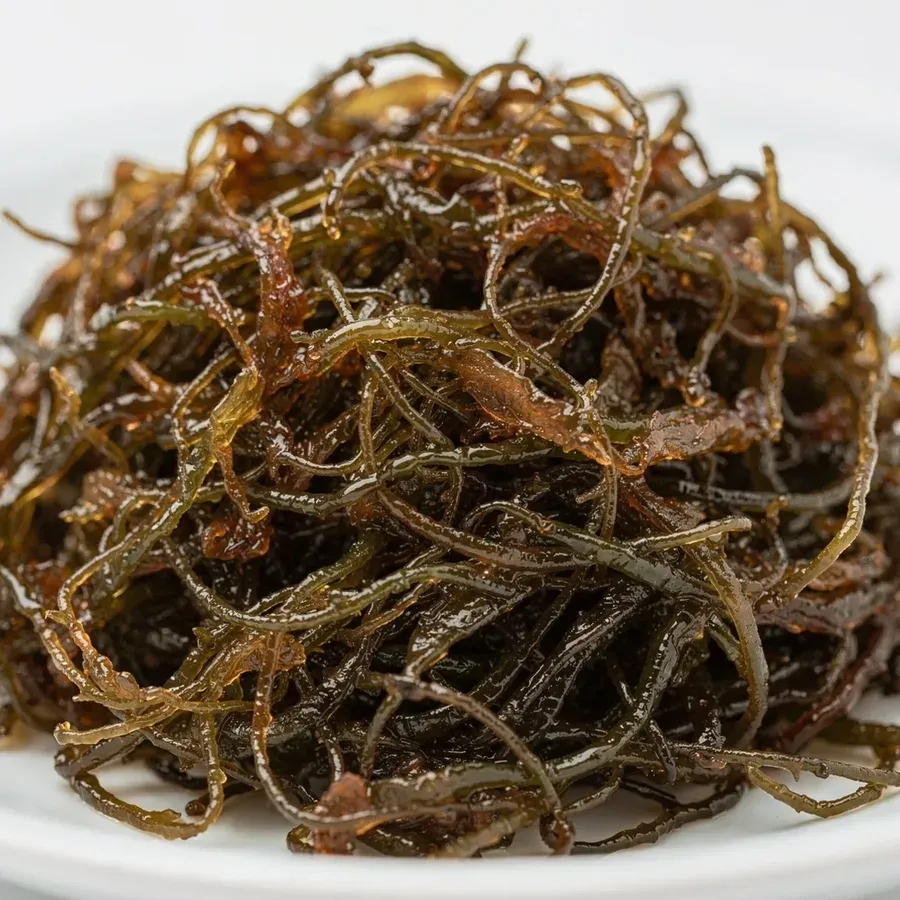
Mozuku is fine brown strands with a slippery, almost jelly-like surface, and that surface is the whole point. It is usually eaten cold as mozuku-su, the strands in a tart mix of rice vinegar and soy sauce, in a small bowl before or between other dishes. Almost all Japanese mozuku is farmed in Okinawa, and it is also the alga that made the word fucoidan known outside the laboratories.
Sensory analysis
Pyramid and character
Aroma
from the bag
- mild seaweed
- ocean
Taste
on the tongue
- slippery texture
- mild ocean tone
- acidity from the dressing
Finish
what lingers
- short
- clean
- cooling
Character 0-100 per axis, set relative to the other entries in the same family. An editorial judgment of a typical serving, not measurements.
Background
Facts
- Raw material
- a collective name for several brown algae; okinawa-mozuku (Cladosiphon okamuranus) is the main farmed variety, ito-mozuku and ishi-mozuku are others
- Cultivation
- 99 percent of Japanese production comes from Okinawa and is almost entirely farmed, not wild-harvested
- History
- the farming was developed by Okinawa's fisheries research in the 1970s; around 2006 production stood at some 20,000 tons a year
- Flavor core
- mild flavor and a clear ocean tone; the texture carries the dish, not the flavor strength
- Fucoidan
- mozuku is one of the richest natural sources of fucoidan, a sulfated polysaccharide that is well studied but not an authority-approved health claim
In the kitchen
Use
- Serving
- cold as mozuku-su, the strands in rice vinegar with soy sauce and sometimes a little dashi, ginger or cucumber
- Method
- salted mozuku is rinsed and left in cold water for a while; ready-marinated mozuku is sold in single portions and eaten straight away
- Note
- do not heat mozuku; the slipperiness that is the whole reward disappears when the strands are boiled
Keep exploring
Related in the Zukan
- Seaweed and kelpFamily
- WakameSea vegetable
- AonoriSea vegetable
- AosaSea vegetable
Evidence
Sources
- Mozuku (Wikipedia) (retrieved 2026-08-12)
- Okinawa Mozuku, the Treasure Under the Sea (OIST) (retrieved 2026-08-12)
- Sea Vegetable Company (retrieved 2026-08-12)
Compiled by Basim Ali Yoshiguchi. .