- Sea vegetable
- 昆布
Kombu
The foundation of the broth, never boiled.
Flavor profile
The strengths are editorial judgments on a scale within the family, not measurements. They can be compared across the seaweed and kelp varieties, not directly against another family.
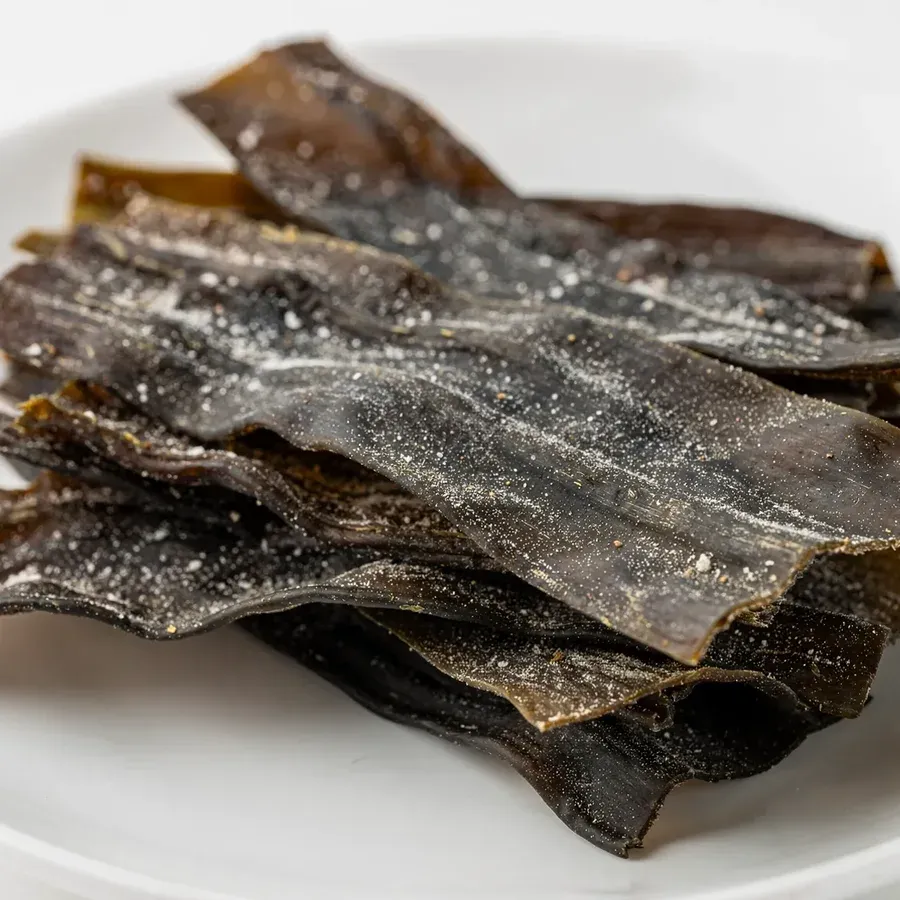
Kombu is the thick brown kelp that makes dashi dashi. It is rarely eaten as it is; instead it steeps in water and gives up its glutamate, the compound behind umami, first isolated from kombu broth in 1908, which gave the fifth basic taste its name. One piece in the pot is enough, and the only rule that matters is not to boil it hard: that pulls slime and bitterness out into the broth.
Sensory analysis
Pyramid and character
Aroma
from the bag
- dried kelp
- ocean
- faintly sweet steam
Taste
on the tongue
- deep umami
- mineral
- soft saltiness
Finish
what lingers
- very long
- broth-like
Character 0-100 per axis, set relative to the other entries in the same family. An editorial judgment of a typical serving, not measurements.
Background
Facts
- Raw material
- brown kelp, mainly Saccharina japonica; most of the Japanese kombu harvest comes from the waters around Hokkaido
- Variants
- ma-kombu (rich and sweet, clear broth), rishiri (clearest of all), hidaka (softens and is eaten), rausu (strongest, clouds the broth); all four have their own entries under dashi ingredients
- Flavor core
- glutamate, the most umami-rich of anything in the dry pantry
- The white powder
- the white film on dried kombu is mannitol, not mold, and should not be washed off
- Use
- dashi first and foremost; kombu already used for broth becomes tsukudani or kombumaki
In the kitchen
Use
- Soaking
- 20 minutes to overnight in cold water for cold-brewed dashi (mizudashi)
- Temperature
- heat toward the boiling point and lift the leaf out before the water boils
- Note
- never wipe off the white powder and never cut slits in the leaf; what should leave the kombu leaves it on its own, into the water
Keep exploring
Related in the Zukan
- Seaweed and kelpFamily
- DashiConcept
- Dashi ingredientsFamily
- Ma-kombuDashi ingredient
- Rishiri-kombuDashi ingredient
- Rausu-kombuDashi ingredient
- Hidaka-kombuDashi ingredient
- Umami synergyConcept
- KatsuobushiDashi ingredient
- NiboshiDashi ingredient
- Hoshi-shiitakeDashi ingredient
- UmamiConcept
- NoriSea vegetable
- WakameSea vegetable
- HijikiSea vegetable
- NukazukePickle
Evidence
Sources
- Kombu (Wikipedia) (retrieved 2026-08-12)
- Kombu (Kelp), Umami Information Center (retrieved 2026-08-12)
- Types of Kombu (Sushi University) (retrieved 2026-08-12)
- Nekko Journal: Dashi, den japanska buljongen (retrieved 2026-08-12)
Compiled by Basim Ali Yoshiguchi. .