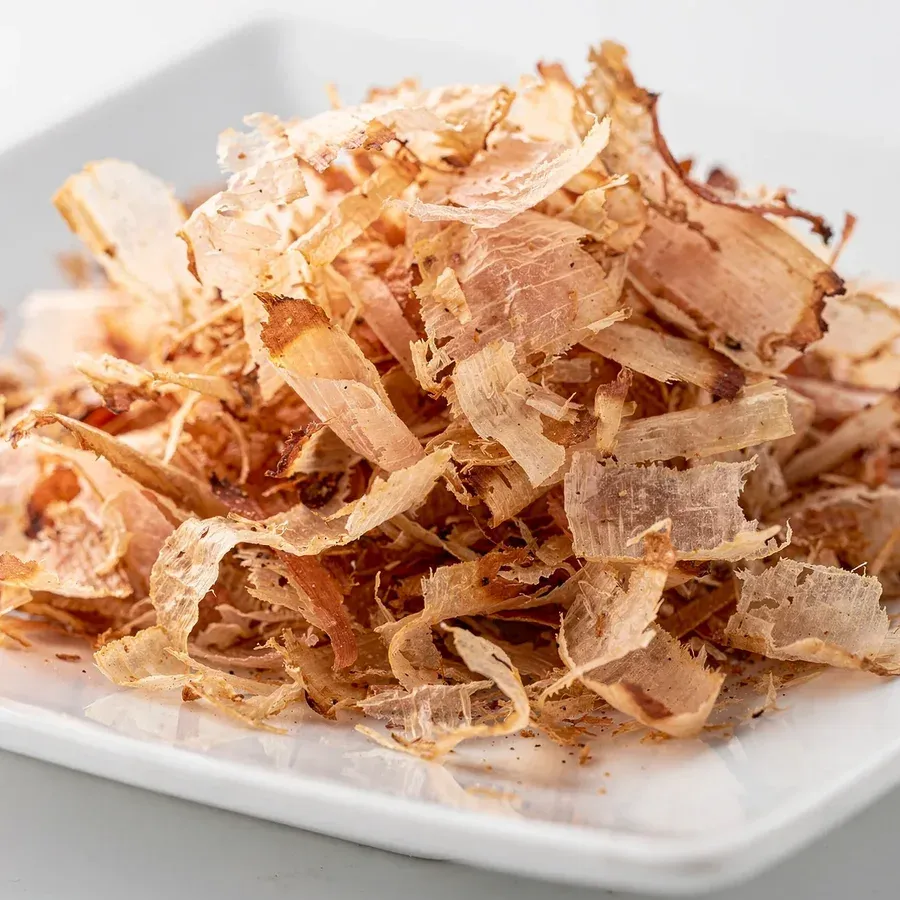
- Dashi ingredient
- 鰹節
Katsuobushi
Shaved smoke, the other half of the broth.
Flavor profile
The strengths are editorial judgments on a scale within the family, not measurements. They can be compared across the dashi ingredients varieties, not directly against another family.
Katsuobushi is bonito that has been simmered, smoked a dozen times, sun-dried and, in the finest version, inoculated with mold again and again. In the end the block weighs less than a fifth of what the fish did. It rings almost like metal when two pieces are knocked together, and it is shaved into paper-thin flakes precisely so the inosinate can reach the water within a minute or so. It is one half of awase dashi, the half that brings smoke and fish rather than ocean.
Sensory analysis
Pyramid and character
Aroma
from the bag
- smoke
- dried fish
- wood
Broth
in the spoon
- inosinate umami
- smokiness
- mild saltiness
Finish
what lingers
- long
- clean
- hearty
Character 0-100 per axis, set relative to the other entries in the same family. An editorial judgment of a typical serving, not measurements.
Background
Facts
- Raw material
- bonito (Katsuwonus pelamis), gutted and filleted
- Processing
- simmered just below the boiling point for one to one and a half hours, then smoked in rounds over oak or similar wood for up to a month
- Variants
- arabushi is the smoked but unmolded product; karebushi and honkarebushi have been inoculated with Aspergillus glaucus and sun-dried two and three or more times respectively
- Flavor core
- inosinate 470 to 700 mg per 100 g, glutamate 30 to 40 mg (Umami Information Center)
- Weight
- the finished karebushi weighs less than 20 percent of the starting weight
- Shaving
- traditionally shaved with a katsuobushi kezuriki, a plane set in a box
In the pot
Broth
- Temperature
- added to water at about 80 degrees Celsius once the kombu has been lifted out
- Time
- 30 seconds to a minute or so, then strain immediately
- Note
- never press the flakes in the strainer; what comes out then is bitterness and cloudiness, not flavor
Keep exploring
Related in the Zukan
- Dashi ingredientsFamily
- DashiConcept
- Umami synergyConcept
- KombuSea vegetable
- Ma-kombuDashi ingredient
- NiboshiDashi ingredient
- FurikakeFamily
- Katsuo-furikakeFurikake variety
Shop and journal
At Nekko
Evidence
Sources
- Katsuobushi (Wikipedia) (retrieved 2026-08-12)
- Katsuobushi (Umami Information Center) (retrieved 2026-08-12)
- Seafood (Umami Information Center), tabell över umamiämnen (retrieved 2026-08-12)
Compiled by Basim Ali Yoshiguchi. . .