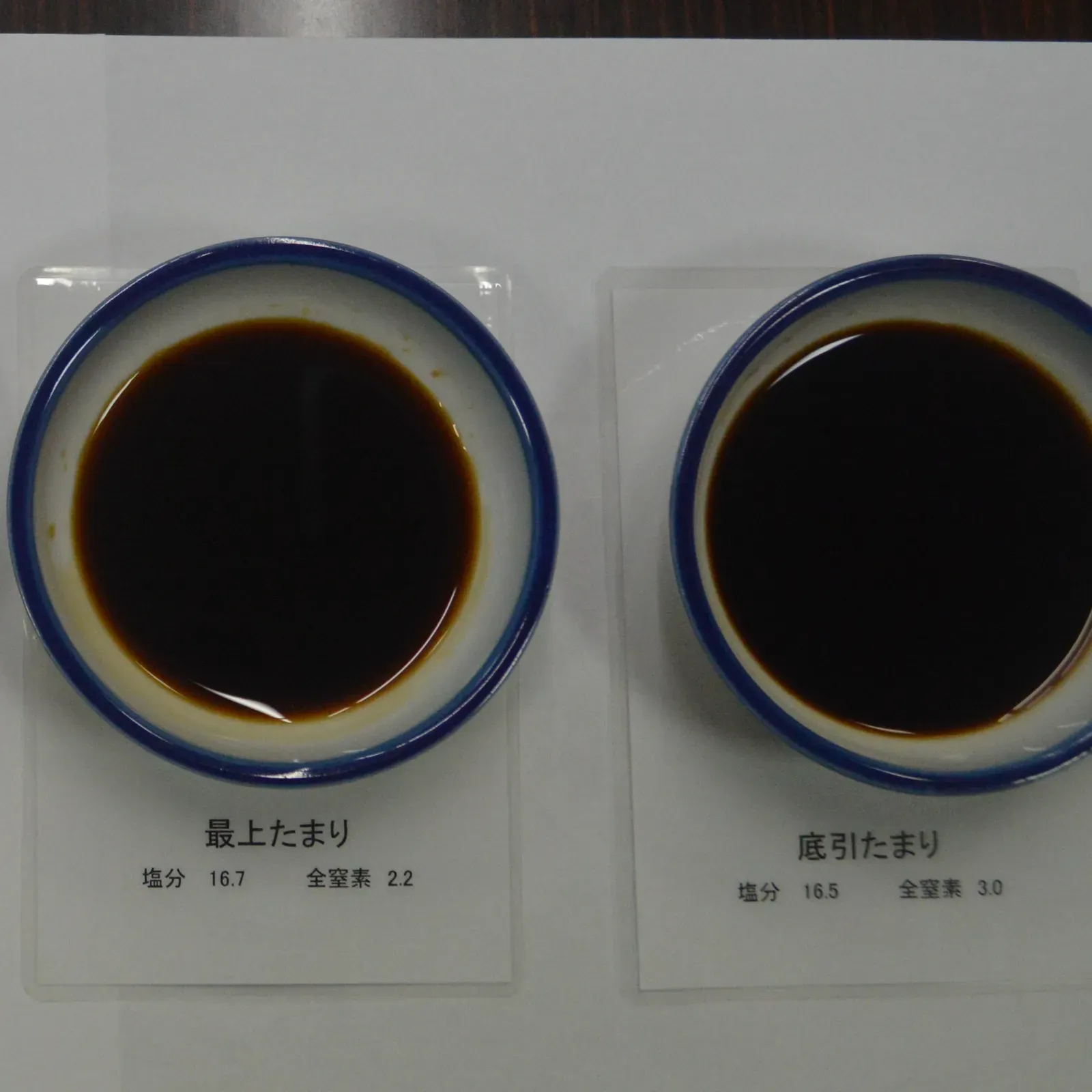

- Soy sauce type
- たまり醤油
Tamari
The original soy sauce, heaviest in both body and umami.
Flavor profile
The strengths are editorial judgments on a scale within the family, not measurements. They can be compared across the soy sauce varieties, not directly against another family.
Tamari is soy sauce's original form: the dark, thick liquid that once seeped from the miso mash and gathered at the bottom of the vat. The name comes from tamaru, to gather. It is brewed almost entirely from soybeans with little or no wheat, which gives the family's densest umami and heaviest body. Abroad it is known as the gluten-free soy sauce, a truth with a caveat spelled out below.
Sensory analysis
Pyramid and character
Aroma
from the tub
- dark ferment
- bean
- caramel
Taste
on the tongue
- dense umami
- salinity
- dark sweetness
Finish
what lingers
- long
- thick
- round
Character 0-100 per axis, set relative to the other entries in the same family. An editorial judgment of a typical serving, not measurements.
Background
Facts
- The name
- from tamaru, to gather; what gathered was the liquid pressed out by the weight of the miso, and the original form was a byproduct before it became a product of its own
- Composition
- almost entirely soybeans, with no or very little wheat; it is bean protein that becomes umami, and the high bean share is the whole character of the type
- Warning
- the JAS standard allows small amounts of wheat in tamari, so gluten-free is a property of the individual bottle, not of the type; whoever buys for the gluten's sake should read the label, not the type name
- Origin
- Chubu is the home ground, with Aichi, Mie, and Gifu as the classic prefectures; the link to miso brewing is documented, and the story of the monk Kakushin in the 1200s is often retold as the starting point
- Use
- the sashimi soy sauce above all, and the lacquer on teriyaki and senbei; the thickness lets it carry gloss where koikuchi runs off
- Proportion
- around 1.5 percent of Japanese production, a small but distinct niche
In the kitchen
Use
- Dosage
- less than koikuchi; the umami is denser and takes more room in the mouth
- Timing
- best late or raw, in the dipping dish or as a glaze toward the end; long simmering evens out exactly what makes it worth its price
- Note
- for gluten-free cooking the label's words apply, not the type's reputation; Western health-aisle tamari is usually certified, Japanese grocery tamari is not always
Keep exploring
Related in the Zukan
- Soy sauceFamily
- KoikuchiSoy sauce type
- SaishikomiSoy sauce type
- MisoFamily
- KojiConcept
Evidence
Sources
- たまり醤油 (japanska Wikipedia) (retrieved 2026-08-15)
- Soy sauce (Wikipedia) (retrieved 2026-08-15)
Compiled by Basim Ali Yoshiguchi. .