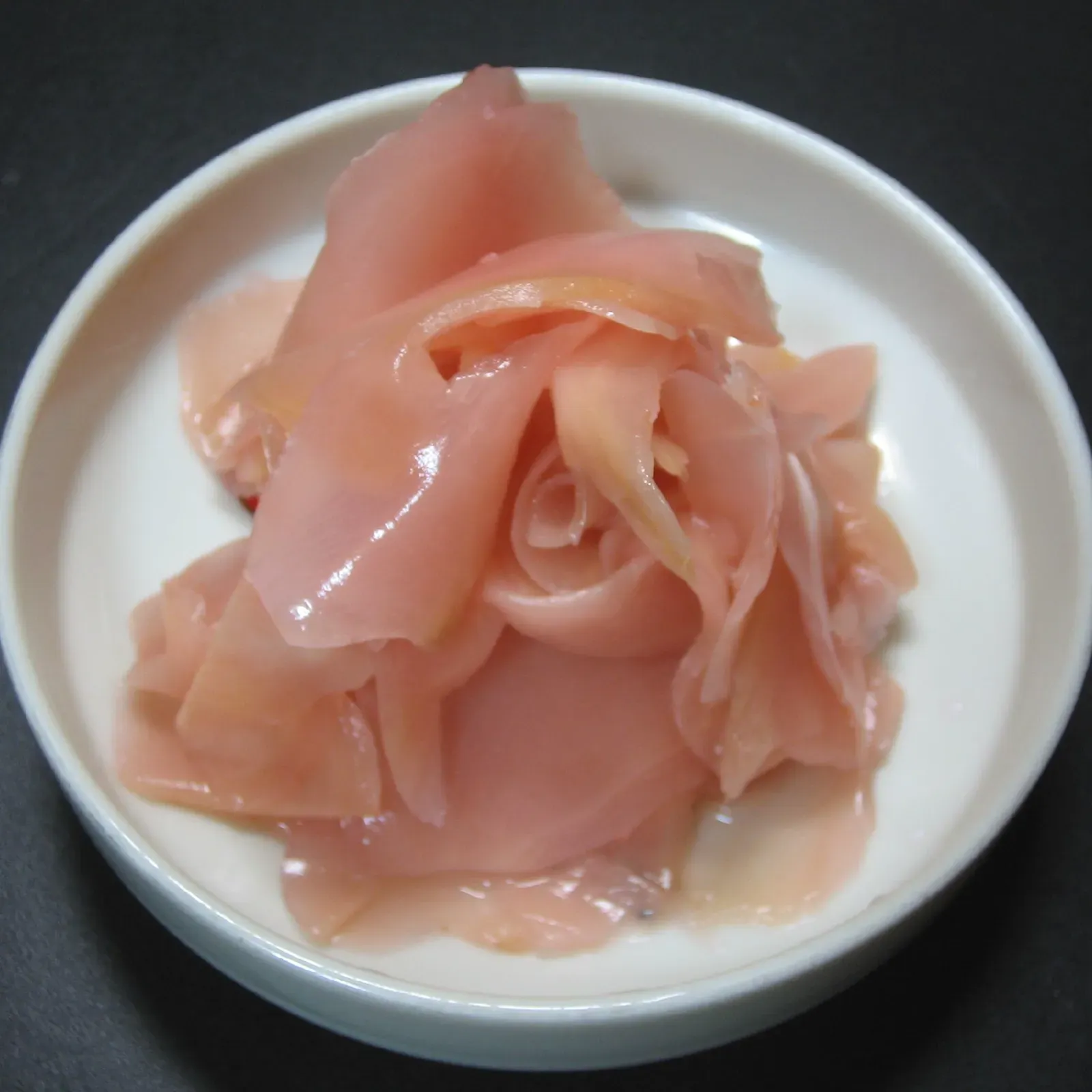

- Pickle
- ガリ
Gari
Eaten between the pieces, never on them.
Flavor profile
The strengths are editorial judgments on a scale within the family, not measurements. They can be compared across the tsukemono varieties, not directly against another family.
Gari is the ginger of the sushi counter: young ginger in thin slices, laid in sweet vinegar brine, amazu. It is eaten between pieces to reset the palate, not on top of them. The pale pink tone comes from the young ginger itself, which blushes in the acidic brine; a glowing pink gari has usually had help. Within the family it is the quick pickle: sweetness and acidity, no ferment depth at all.
Sensory analysis
Pyramid and character
Aroma
from the jar
- ginger
- vinegar
- sweetish
Taste
on the tongue
- sweetness
- acidity
- warmth
Finish
what lingers
- clean
- short
- warm
Character 0-100 per axis, set relative to the other entries in the same family. An editorial judgment of a typical serving, not measurements.
Background
Facts
- Raw material
- young ginger, harvested before the root has turned fibrous and harsh; it is the youth that makes the slices edible in quantity
- Method
- the slices are lightly salted and laid in amazu, sweet vinegar brine; no fermentation, the brine does all the work
- Color
- the cut surfaces of truly young ginger blush naturally in acidic brine; if the color is evenly and strongly pink it usually comes from dye
- Usage
- eaten between pieces of sushi as a palate cleanser, with fingers or chopsticks, never on top of a piece; in sushi slang the ginger is gari and the tea is agari
- Confusion
- beni shoga is the other sushi ginger, mature ginger in shreds, laid in salty umezu instead of sweet amazu, and it belongs to street food rather than the sushi counter
At the table
Serving
- Dosage
- a few slices between pieces is enough; the point is the pause, not the side dish
- Timing
- between two different fish, or after a rich piece; the acidity and the ginger's bite ready the palate for the next
- Note
- an opened jar keeps for months in the fridge in its brine; if the brine turns cloudy or the slices go soft, it is done
Evidence
Sources
- Pickled ginger (Wikipedia) (retrieved 2026-08-15)
- 生姜 (japanska Wikipedia) (retrieved 2026-08-15)
- Tsukemono (Wikipedia) (retrieved 2026-08-15)
Compiled by Basim Ali Yoshiguchi. .