
- Pickle
- らっきょう
Rakkyo
The crunch on the curry plate.
Flavor profile
The strengths are editorial judgments on a scale within the family, not measurements. They can be compared across the tsukemono varieties, not directly against another family.
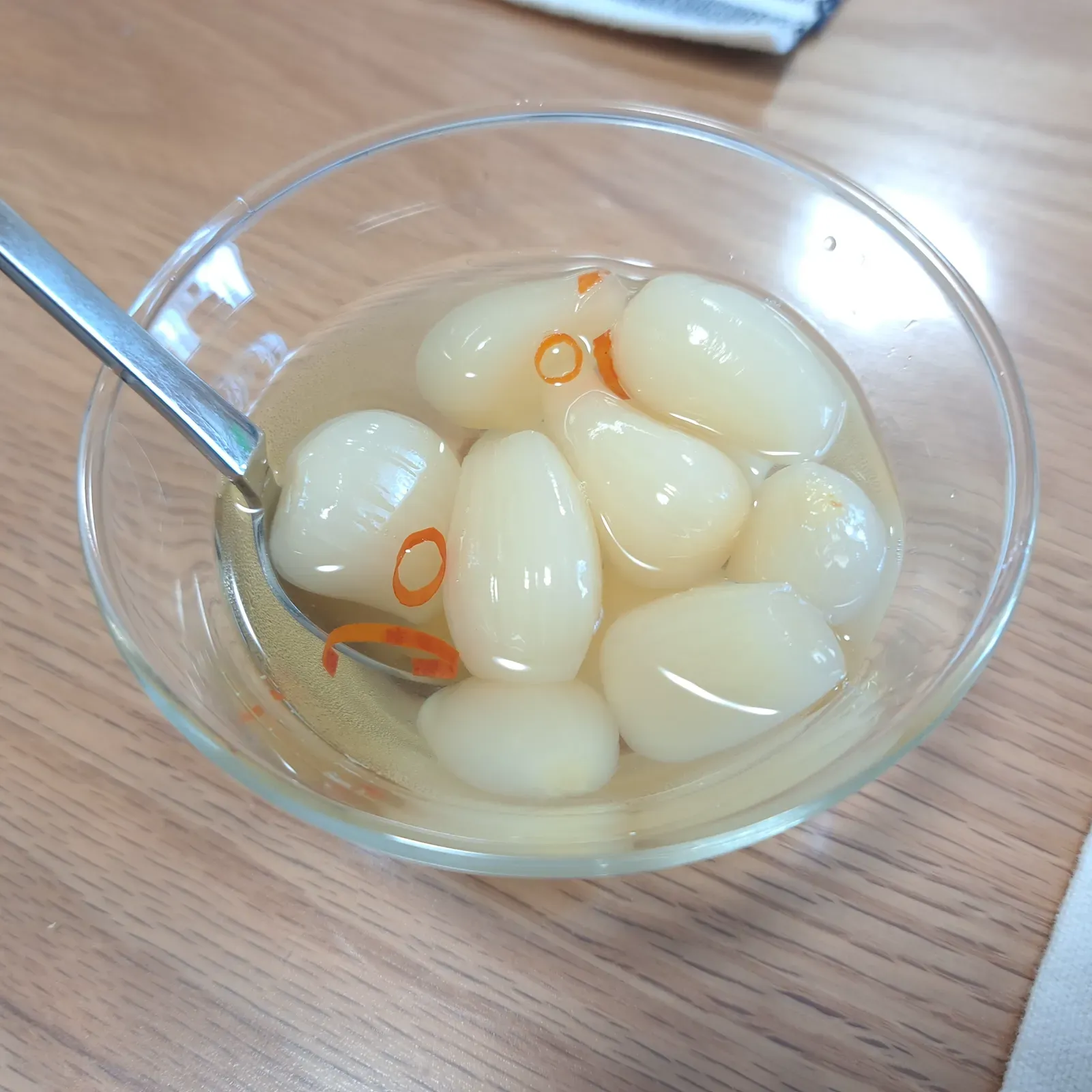
Rakkyo are small white bulbs, Allium chinense, salted and then laid in sweet vinegar brine. The result is the crunchiest member of the family: a glossy, sweet-and-sour crackle with a mild allium bite, and the fixed companion to Japanese curry. The most famous fields lie in the sand dunes of Tottori, where the bulbs have to fight for their firmness.
Sensory analysis
Pyramid and character
Aroma
from the jar
- allium
- sweet vinegar
- clean
Taste
on the tongue
- sweetness
- acidity
- mild allium bite
Finish
what lingers
- crunchy
- short
- fresh
Character 0-100 per axis, set relative to the other entries in the same family. An editorial judgment of a typical serving, not measurements.
Background
Facts
- Raw material
- Allium chinense, a small segmented bulb in the family of garlic and shallots; the white, dense bulbs with no green tinge are valued highest
- Origin
- came from China to Japan in the ninth century as a medicinal plant and became food in the Edo period; today Tottori and Fukui are the classic growing regions, and the rakkyo blossom is Tottori's city flower
- Method
- the bulbs are salted first, often with a short fermentation in the brine, and then laid in amazu, sweet vinegar brine; the salt stage is what makes them keep, the brine what makes them sweet
- Harvest
- planted in late summer and harvested the following summer once the tops have withered; they must go into brine quickly after harvest to keep the crackle
- Classic pairs
- the curry plate's fixed pair is rakkyo and fukujinzuke, the soy-brined vegetable mix; rakkyo brings the acidity and the crunch, fukujinzuke the sweetness
- Function
- the bulb's sulfur compounds are said to aid the uptake of vitamin B1 from the pork in the curry, an explanation for the pairing that Japanese sources gladly retell
At the table
Serving
- Dosage
- two or three bulbs beside the curry; they are assertive, and a fistful is a possible but soggy evening
- Serving
- whole as they are, or sliced into salads and tartars where the crackle is needed
- Note
- keeps a long time in the fridge in its brine; if the bulbs go soft they have either frozen or stood too long
Evidence
Sources
- Allium chinense (Wikipedia) (retrieved 2026-08-15)
- ラッキョウ (japanska Wikipedia) (retrieved 2026-08-15)
- Fukujinzuke (Wikipedia) (retrieved 2026-08-15)
Compiled by Basim Ali Yoshiguchi. .