
- Citrus fruit
- 香母酢
Kabosu
The one you pick when you want juice.
Flavor profile
The strengths are editorial judgments on a scale within the family, not measurements. They can be compared across the citrus varieties, not directly against another family.
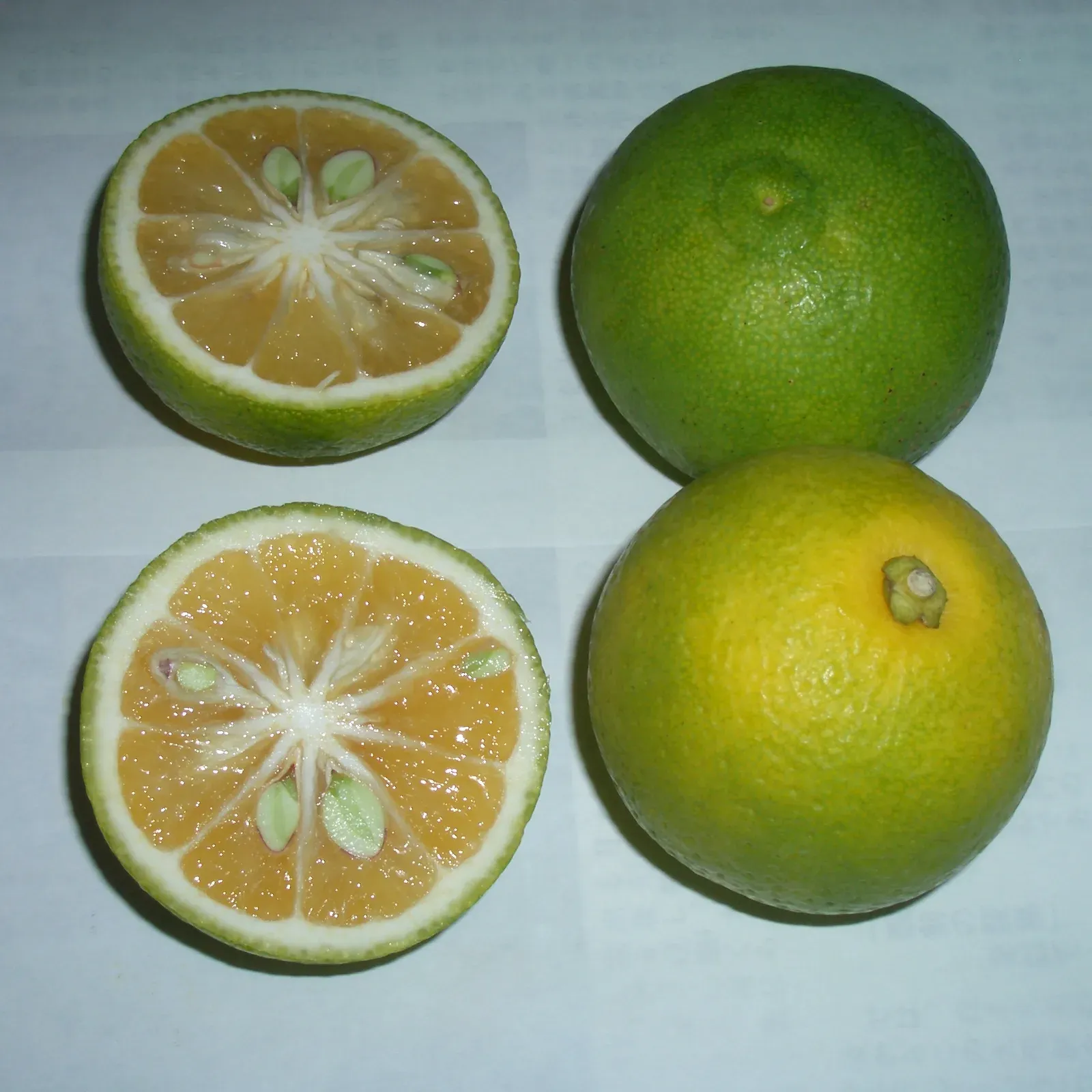
Kabosu is the family's juice fruit: the largest of them, roughly a tennis ball, with rounder acidity and a milder aroma than sudachi. Ninety-nine percent of it comes from Oita, where it belongs with fugu and with poached white fish so naturally that it is often set out without anyone asking. You choose kabosu when you want a real splash of juice, not for the aroma.
Sensory analysis
Pyramid and character
Aroma
from the peel
- green peel
- grass
- citrus
Taste
on the tongue
- acidity
- freshness
- faint bitterness
Finish
what lingers
- clean
- short
- soft
Character 0-100 per axis, set relative to the other entries in the same family. An editorial judgment of a typical serving, not measurements.
Background
Facts
- Origin
- Oita on Kyushu accounts for effectively the entire Japanese crop, 5,400 tons of 5,460 in 2018; Usuki, Taketa, Bungo-ono, and Kunisaki are the main growing towns
- The name
- written both 臭橙, literally foul-smelling citrus, and 香母酢, roughly fragrant mother vinegar; both read kabosu, and the trade uses the latter
- Kinship
- Citrus sphaerocarpa, which DNA places as a cross between yuzu and kunenbo
- Size
- 100 to 150 grams, a tennis ball against the sudachi's ping-pong ball
- Confusion
- kabosu and sudachi are mixed up constantly, but the difference shows, since kabosu is three times the size and carries a small raised ring around the scar left by the pistil at the top, which the sudachi does not have
- Harvest
- greenhouse March to July, outdoor August to October, stored from mid-October to February; picked green, turning yellow if left on the tree
- Use
- fugu and poached white fish are the classic pairings, then ponzu for the hot pot, sunomono, miso soup, noodles, and a splash in shochu
- History
- kabosu from Oita was registered as a geographical indication in 2017, but the registration was struck in March 2026, one of only three such cases in the Japanese system
At the table
Use
- Dosage
- half a fruit covers two servings, and it is large enough that a whole one easily becomes too much
- Timing
- squeezed over the food just before serving, or stirred into a ponzu kept beside the pot
- Note
- the juice takes heat better than the aroma does, so it can go into a sauce; what goes first is the note from the peel
Evidence
Sources
- Kabosu (japanska Wikipedia) (retrieved 2026-08-14)
- Kabosu (Wikipedia) (retrieved 2026-08-14)
- 地理的表示(GI)保護制度について, registerläget juli 2026 (MAFF) (retrieved 2026-08-14)
Compiled by Basim Ali Yoshiguchi. .